Queen's Bath Kandy Sri Lanka - The Bathing Pavilion for Queen
Use Google Translator at Navigation Bar to read in Sinhala or Tamil or in any other Language
Stone Bathing Pool for Queen Venkatha Ranga Jemmal of King Sri Wickrama Rajasinha
Queen's Bath of Sri Lanka
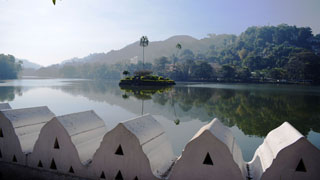
The Queens Bathing Pavilion of Kandy which was used by the Queen of last king of Sri Lanka as the Queen's Bath or Ulpange has an interesting background in Kandyan History.
There are only a few Queen’s Baths mentioned in the written world history and the top reference goes to a natural tide pool created by Lava in a sea side place in Princeville of Hawai used by ancient Hawaiian Royalty. The second Queen’s Bath that is mentioned is at Hampi, of Vijayanagara Empire,now a World Heritage site at Bangalore, India. Other than the above mentioned Queen’s Baths, there don’t seemed to be other popular places coming under this category.
Upon such a background we are presenting the Sri Lanka’s counterpart that is popularly called as the Queen’s Bathing Pool or Ulpange, built little over two centuries back by the Sri Lanka’s last king for his Queen at Kandy near to the Royal Palace. Being a UNESCO World heritage site, Kandy has many important architectural monuments, and the prime site being the Temple of the Tooth Relic which is a live site even in the present day. The Queen's Bath, King Sri Wickrama Rajasinha made for his Queen Rengammal is not what we are used to see today as enclosed in a huge building. In 1817, the Bathing Pool was open at sides with few columns around it. There was a small high roof square shaped pavilion near the pool which could have been used as a waiting place for the royalty. The landscape painting by Lt. William Lyttleton done in 1817, two years after the King's departure, gives valuble clues to the city's landscape around Temple of the Tooth, King's Palace, Kandy Lake, Udawatta Forest, Bogambara Lake and the Streets and structures of the city.
Queen's Bath History
This Queen’s Bath is said to be constructed in 1806 by King Sri Wickrama Rajasinghe for his Queen Venkatha Ranga Jammal(Rengammal) and other companion queens 200 meters to South from the King’s Palace entrance hall. This Bathing Pool is constructed with molded stone slabs with a stone deck running round the pool area . According to the Archeology Department information, this pool is 19 meters in length and 9.4 meters in width being 3.45 meters in depth [ 62 feet (L) x 30 feet (W) x 11 feet (D) ] and has a rectangular shape with eight sides. The two shorter section of this oblong shaped pool has three sides each thus forming an oblong octagon.
Queen's Bathing House , as we see today
According to the historical timeline, this stone made pool was constructed before any work on the Kandy Lake (Kiri Muhuda) had been initiated. Since the location of the stone bathing pool had been at the border of Tigol Vela paddy field area , the whole construction surrounding the pool area should have been completed- as we see today- in stone work with a solid foundation in that marshy land. The meaning of the Sinhala word ‘Ulpange’ reads as “the spring water structure“ as already suggested by the Archeology Department's Information Board erected in front of Queens’ Bathing Pool.
Inside of building where the Bathing Pool is seen
Since the Ulpange was constructed (1806) before the manmade Kandy lake was constructed and filled with water ( most probably in the year of 1812), the Queen’s Bathing Pavilion’s water source should have been a spring water source. There should have been a fair amount of spring water entering the pool area which is of 62’ x 30’ approximately as per data provided. This can be deduced by the fact that there is a an half circle shaped opening visible in the stone pool structure to take the excess water of the bathing pool to outside which is coming out of the spring, thus maintaining a certain water level in the pool as can be seen from an earlier photograph (year 2005) of the pool. So at the time of construction of this stone bathing pool, there always should had been fresh spring water sprouting from the pool, thus naming it Ulpange. Letters ‘Ul ‘–a shorten form for Ulpath or Spring. ‘pan’ is for Water. ‘ge’ is for House. Denoting ’Structure of Spring Water’.
Queen's Bathing Pool with proper water level reveals the correct perspective of the Bathing Pool
If you consider the fact that before the British cleared the hillside area of Udawatta Kale above Dalada Maligawa ( Temple of the Tooth Relic) after 1815, the area was endowed with a natural forest coverage so there was the necessary facts for the environment to create spring water sources. But today with the urbanization, we no more have the necessary surroundings of forest cover to have natural spring water sources as forgone years.Changes were done to the original stone pool deck by the British during their administration as they wanted to utilize the space for a building. For that they have filled the pool probably by first plugging the spring water source and then cementing the whole pool area that was converted to a floor area. A Kandyan style building was erected utilizing this floor area with an upper floor as one can see today. They have utilized the building as a library from 1828 . This had been called as ‘United Service Library’
Portrait of Queen Venkatha Ranga Jammal
When the UNESCO Cultural Triangle project was initiated in around 1980, the pool was excavated and reopened and has preserved the building as a historical monument. Today the history of Ulpange is being revisited as the Queen’s Bathing Pavilion, King Sri Wickrama Rajasingha made for his Queen Venkatha Ranga Jammal fondly called as Rengammal.
Queen's Bath History and Landscape Paintings of 1817 AD
New dimensions to the Kandyan history can be made if one carefully study the landscape paintings of Lt. William Lyttleton (paintings done in 1817), John Deschamps (paintings done in 1845), Friedrich Wilhelm Waldermar (paintings done in 1853), which can be found in ‘Early Prints of Ceylon 1800-1900’, a book by R.K.de Silva. Referring the portion of the painting of Lt. William Lyttleton, comprising the Ulpange, we can observe that in 1817, the Queen’s Bathing Pool was open to sky and with about some columns erected on the pool deck area. ( Dalada Maligawa Pattirippuwa or the Octagon Building of Temple of the Tooth can be seen at left upper half side of the painting.) These could be the columns we see today inside the Bathing Pool's oblong octagon shaped pavement that have been meant for a Roof structure to cover the Bathing Pool water area or else for a already existed Roof. A high roofed square pavilion is erected just before the bathing pool which must have utilized as a Waiting area for the Queens visiting the Ulpange. Though we are used to see the Queen’s Bathing Pavilion situated in the Kandy Lake’s water, in reality the Ulpange was constructed six years before the Lake was constructed and filled. So literally there was no lake but the Tigol Wela paddy field with a marshy land on which the Queen’s pool was constructed. So the water source for the Bathing Pool definitely should have been from a water sprout of a natural spring surfacing beneath the pool area that had been surrounded by cemented stone slabs to construct the bathing pool basin and to raise the water level of oblong Octagonal shaped pool we see today. A half round cavity running from the pool to the outside through the deck can be seen when Lake’s water level becomes less.
.jpg)